
Who should get to redraw Colorado’s congressional districts between censuses—and what rules should...
Should Colorado keep one income-tax rate for everyone—or charge different rates on different portions of income?
That is the central question behind Amendment 87, the graduated-income-tax proposal on Colorado’s November 3, 2026 ballot. The measure combines a constitutional repeal with changes to state statutes. It requires a simple majority, rather than 55 percent, to pass. The official Colorado Blue Book analysis explains the proposal and its voting requirements. (leg.colorado.gov)
Supporters describe it as a way to distribute taxes more fairly and strengthen public services. Opponents warn that higher taxes on successful businesses and high earners could undermine Colorado’s economy. Those competing perspectives appear in CPR News’ voter guide. (cpr.org)
Amendment 87 conflicts with Proposition 136: Income Tax Rate Limit
What happens if both pass is not clear. According to the Blue Book, "Amendment 87 creates a graduated income tax, where higher tax rates are applied to higher incomes and lower tax rates are applied to lower incomes earned by a household or business. If both Amendment 87 and Proposition 136 are approved by voters, the proposed rate for incomes over $500,000 in Amendment 87 would be higher than the 4.4 percent limit in Proposition 136. Generally, when parts of voter-approved measures conflict, the policy outcome is determined by the measure that receives more votes. However, if both measures are approved by voters, the exact outcome is unclear. The state legislature or a court will determine how to resolve any conflicts."I am confused by the assessment that "if both measures are approved, the exact outcome is unclear." Would the Constitution not overrule a legislative measure?
Let’s look at what the measure actually changes—and the strongest arguments on both sides.
What Your Vote Means
A YES vote
A YES vote would replace Colorado’s flat state income tax with graduated rates, dedicate additional revenue to education, health care, and early childhood services, and exempt that additional revenue from TABOR’s revenue limit. (leg.colorado.gov)
A NO vote
A NO vote would retain the constitutional requirement for a flat state income-tax rate. It would not enact Amendment 87’s new tax structure or funding provisions. (leg.colorado.gov)
Official Ballot Language
The Secretary of State identifies Amendment 87 as Initiative 195: Graduated Income Tax.
Its ballot question begins by asking whether state taxes should increase $2.7 billion annually, then describes the proposed graduated rates, permitted spending, and revenue exemption. The question also includes a table estimating average tax changes by income category. Read the complete wording on the Secretary of State’s official ballot-measures page, under Amendment 87. (sos.state.co.us)
An important distinction: The $2.7 billion ballot figure is a maximum estimated revenue increase, accounting for possible forecast error—not the central revenue forecast. The Legislative Council’s fiscal summary explains that distinction. (staging.leg.colorado.gov)
Official Amendment Language
Be it Enacted by the People of the State of Colorado:
SECTION 1. Legislative Declaration
(1) The people of the state of Colorado find, determine, and declare that:
(a) Colorado taxpayers are entitled to a fair and equitable tax system that recognizes the affordability challenges facing working families, promotes a vibrant statewide economy, and adequately supports our public education, health care, and child care systems and other essential public services available to all Coloradans;
(b) Colorado’s current flat income tax system, unlike the graduated income tax system atthe federal level and in 27 other states, taxes millionaires and corporations at the same rate as regular working people;
(c) Combining state income, sales, and property taxes, the wealthiest 1% of Coloradans those making over $850,000 per year–pay only 7% of their income in state and local taxes every year, whereas the 60% of Coloradans making between $25,000 and $150,000 per year pay between 9-10%.
(d) The 97% of Colorado taxpayers making less than $500,000 would benefit from a tax cut to help them afford the high cost of living;
(e) The Taxpayer’s Bill of Rights, or the TABOR amendment, has significantly limited the ability of state and local governments to invest in supporting teachers and care workers, building infrastructure, and keeping up with a changing economy;
(f) TABOR can be amended to allow a graduated income tax without impacting TABOR refunds or the voters’ right to approve any future tax increases;
(g) As demonstrated by recent state-commissioned adequacy studies, Colorado’s public schools have been underfunded for decades, and despite the elimination of the Budget Stabilization Factor in 2024, teacher wage competitiveness is still 50th in the country.
(h) Health care in Colorado is too expensive, and the cuts in the federal budget bill are expected to exceed $2 billion per year by 2032, with rural hospitals and clinics facing the greatest risks for closing or limiting services; and
(i) Child care in Colorado is too expensive, making it harder for parents to work while raising their families, and yet wages are so low that 46 percent of early childhood workers in the state rely on social welfare programs like Medicaid and SNAP;
(2) The people of the state of Colorado find, therefore, that:
(a) A graduated income tax system will:
(I) Better support Colorado’s children and families, working people, and older adults by cutting taxes for individuals and small businesses making less than $500,000 per year while only increasing taxes on individuals and corporations making more than $500,000 per year;
(II) Increase Colorado’s ability to adequately invest in our public schools, health care, and child care systems and programs to improve the affordability of health care and child care;
(b) A graduated income tax system will not:
(I) Change the Constitutional requirement that the state government cannot raise any tax rates without another vote of the people;
(II) Reduce or otherwise impact TABOR refunds, because any revenue raised from Colorado’s current 4.4% flat income tax, 2.9% sales tax, and various other taxes and fees that exceeds the TABOR spending limit will be required to be refunded to taxpayers;
(c) All new revenue from graduated income tax that exceeds what would have otherwise been collected under Colorado’s current tax rates will be transferred into the Colorado’s Future Fund, with spending limited to the following purposes:
(I) Improving our public education system, increasing pay to attract and retain great teachers, reducing class sizes, supporting rural schools, and supporting affordable pathways to higher education and workforce training;
(II) Improving our health care system, making health care more affordable, replacing federal Medicaid funds that were cut by the federal budget bill, implementing new requirements in the federal budget bill, increasing access to mental and behavioral health care and primary care, supporting services for older adults and people with disabilities, increasing access to nutritious food, supporting our health care workforce, and supporting rural hospitals and clinics;
(III) Improving our early child care and education systems, helping families afford child care, and increasing pay to attract and retain great child care providers;
(d) New revenues are intended to supplement rather than supplant existing funding;
(e) Taxpayers will be able to monitor and assure responsible and effective usage of all new revenue based on the following requirements:
(I) The nonpartisan office of legislative council will produce an annual report on all spending of new revenue that will be accessible to the public in various formats including the general assembly’s website with plain language descriptions and understandable data visualizations;
(II) The nonpartisan and independent office of the state auditor will annually audit this report and present findings to the Joint Budget Committee and the public;
SECTION 2 In the constitution of the state of Colorado, section 20 of article X, amend (8)(a) as follows:
(8) Revenue limits. (a) New or increased transfer tax rates on real property are prohibited. No new state real property tax or local district income tax shall be imposed. Neither an income tax rate increase nor a new state definition of taxable income shall apply before the next tax year. Any income tax law change after July 1, 1992 shall also require all taxable net income to be taxed at one rate, excluding refund tax credits or voter-approved tax credits, with
no added tax or surcharge.
SECTION 3. In Colorado Revised Statutes, 39-22-104, amend (1.7)(c) and (2); and add (1.8) as follows:
39-22-104. Income tax imposed on individuals, estates, and trusts - report - tax preference performance statement - legislative declaration - definitions - repeal.
(1.7)(c) Except as otherwise provided in section 39-22-627, subject to subsection (2) of this section, with respect to taxable years commencing on or after January 1, 2022, BUT BEFORE JANUARY 1, 2027, a tax of four and forty one-hundredths percent is imposed on the federal taxable income, as determined pursuant to section 63 of the internal revenue code, of every individual, estate, and trust.
(1.8)(a) EXCEPT AS OTHERWISE PROVIDED IN SECTION 39-22-627, SUBJECT TO SUBSECTION (2) OF THIS SECTION, WITH RESPECT TO TAXABLE YEARS COMMENCING ON OR AFTER JANUARY 1, 2027, A GRADUATED TAX IS IMPOSED ON FEDERAL TAXABLE INCOME, AS DETERMINED BY SECTION 63 OF THE INTERNAL REVENUE CODE, OF EVERY INDIVIDUAL, ESTATE, AND TRUST, AS FOLLOWS:
(I) FOR FEDERAL TAXABLE INCOME LESS THAN OR EQUAL TO TWENTY FIVE THOUSAND DOLLARS, THE TAX IS THREE AND SEVENTY ONE-HUNDREDTHS PERCENT;
(II) FOR FEDERAL TAXABLE INCOME GREATER THAN TWENTY FIVE THOUSAND DOLLARS BUT LESS THAN OR EQUAL TO ONE HUNDRED THOUSAND DOLLARS, THE TAX IS (A) THREE AND SEVENTY ONE-HUNDREDTHS PERCENT ON THE AMOUNT UP TO AND INCLUDING TWENTY FIVE THOUSAND DOLLARS AND (B) FOUR AND TWENTY ONE-HUNDREDTHS PERCENT ON THE AMOUNT GREATER THAN TWENTY FIVE THOUSAND DOLLARS BUT LESS THAN OR EQUAL TO ONE HUNDRED THOUSAND DOLLARS;
(III) FOR FEDERAL TAXABLE INCOME GREATER THAN ONE HUNDRED THOUSAND DOLLARS BUT LESS THAN OR EQUAL TO FIVE HUNDRED THOUSAND DOLLARS, THE TAX IS (A) THREE AND SEVENTY ONE-HUNDREDTHS PERCENT ON THE AMOUNT UP TO AND INCLUDING TWENTY FIVE THOUSAND DOLLARS, (B) FOUR AND TWENTY ONE-HUNDREDTHS PERCENT ON THE AMOUNT GREATER THAN TWENTY FIVE THOUSAND DOLLARS BUT LESS THAN OR EQUAL TO ONE HUNDRED THOUSAND DOLLARS, AND (C) FOUR AND FORTY ONE-HUNDREDTHS PERCENT ON THE AMOUNT GREATER THAN ONE HUNDRED THOUSAND DOLLARS;
(IV) FOR FEDERAL TAXABLE INCOME GREATER THAN FIVE HUNDRED THOUSAND DOLLARS BUT LESS THAN OR EQUAL TO SEVEN HUNDRED FIFTY THOUSAND DOLLARS, THE TAX IS (A) THREE AND SEVENTY ONE-HUNDREDTHS PERCENT ON THE AMOUNT UP TO AND INCLUDING TWENTY FIVE THOUSAND DOLLARS, (B) FOUR AND TWENTY ONE-HUNDREDTHS PERCENT ON THE AMOUNT GREATER THAN TWENTY FIVE THOUSAND DOLLARS BUT LESS THAN OR EQUAL TO ONE HUNDRED THOUSAND DOLLARS, (C) FOUR AND FORTY ONE-HUNDREDTHS PERCENT ON THE AMOUNT GREATER THAN ONE HUNDRED THOUSAND DOLLARS BUT LESS THAN OR EQUAL TO FIVE HUNDRED THOUSAND DOLLARS, AND (D) SEVEN AND FORTY NE-HUNDREDTHS PERCENT ON THE AMOUNT GREATER THAN
FIVE HUNDRED THOUSAND DOLLARS;
(V) FOR FEDERAL TAXABLE INCOME GREATER THAN SEVEN HUNDRED FIFTY THOUSAND DOLLARS BUT LESS THAN OR EQUAL TO ONE MILLION DOLLARS, THE TAX IS (A) THREE AND SEVENTY ONE-HUNDREDTHS PERCENT ON THE AMOUNT UP TO AND INCLUDING TWENTY FIVE THOUSAND DOLLARS, (B) FOUR AND TWENTY ONE-HUNDREDTHS PERCENT ON THE AMOUNT GREATER THAN TWENTY FIVE THOUSAND DOLLARS BUT LESS THAN OR EQUAL TO ONE HUNDRED THOUSAND DOLLARS, (C) FOUR AND FORTY ONE-HUNDREDTHS PERCENT ON THE AMOUNT GREATER THAN ONE HUNDRED THOUSAND DOLLARS BUT LESS THAN OR EQUAL TO FIVE HUNDRED THOUSAND DOLLARS, (D) SEVEN AND FORTY ONE-HUNDREDTHS PERCENT ON THE AMOUNT OVER FIVE HUNDRED THOUSAND DOLLARS BUT LESS THAN OR EQUAL TO SEVEN HUNDRED FIFTY THOUSAND DOLLARS, AND (E) SEVEN AND NINETY ONE-HUNDREDTHS PERCENT ON THE AMOUNT OVER SEVEN HUNDRED FIFTY THOUSAND DOLLARS; AND
(VI) FOR FEDERAL TAXABLE INCOME GREATER THAN ONE MILLION DOLLARS, THE TAX IS (A) THREE AND SEVENTY ONE-HUNDREDTHS PERCENT ON THE AMOUNT UP TO AND INCLUDING TWENTY FIVE THOUSAND OLLARS, (B) FOUR AND TWENTY ONE-HUNDREDTHS PERCENT ON THE AMOUNT GREATER THAN TWENTY FIVE THOUSAND DOLLARS BUT LESS THAN OR EQUAL TO ONE HUNDRED THOUSAND DOLLARS, (C) FOUR AND FORTY ONE-HUNDREDTHS PERCENT ON THE AMOUNT GREATER THAN ONE HUNDRED THOUSAND DOLLARS BUT LESS THAN OR EQUAL TO FIVE HUNDRED THOUSAND DOLLARS, (D) SEVEN AND FORTY ONE-HUNDREDTHS PERCENT ON THE AMOUNT GREATER THAN FIVE HUNDRED THOUSAND DOLLARS BUT ESS THAN OR EQUAL TO SEVEN HUNDRED FIFTY THOUSAND DOLLARS, (E) SEVEN AND NINETY ONE-HUNDREDTHS PERCENT ON THE AMOUNT GREATER THAN SEVEN HUNDRED FIFTY THOUSAND DOLLARS BUT LESS THAN OR EQUAL TO ONE MILLION DOLLARS; AND (F) EIGHT AND FORTY ONE-HUNDREDTHS PERCENT ON THE AMOUNT GREATER THAN ONE MILLION DOLLARS.
(b) FOR PURPOSES OF SUBSECTION (1.8)(a) OF THIS SECTION, TAXABLE NET INCOME FROM
THE SALE OR EXCHANGE OF A PRINCIPAL RESIDENCE EXCEEDING THE AMOUNT EXCLUDED FROM
FEDERAL TAXABLE INCOME UNDER SECTION 121 OF THE INTERNAL REVENUE CODE SHALL BE SUBJECT TO
TAX UNDER THIS SECTION AT THE RATE OF FOUR AND FORTY ONE-HUNDREDTHS PERCENT.
(2) Prior to the application of the rate of tax prescribed in subsection (1), (1.5), or (1.7),
OR (1.8) of this section, the federal taxable income shall be modified as provided in subsections
(3) and (4) of this section.
SECTION 4. In Colorado Revised Statutes, 39-22-301, amend (1)(d)(I)(K) and add (1)(d)(I)(L) as follows:
39-22-301. Corporate tax imposed – repeal. (1)(d)(I)(K). Except as otherwise provided in section 39-22-627, for income tax years commencing on or after January 1, 2022, BUT BEFORE JANUARY 1, 2027, four and forty one-hundredths percent of the Colorado net income.
(1)(d)(I)(L) EXCEPT AS OTHERWISE PROVIDED IN SECTION 39-22-627, FOR INCOME TAX YEARS COMMENCING ON OR AFTER JANUARY 1, 2027, A GRADUATED TAX IS IMPOSED ON COLORADO NET INCOME, AS DETERMINED UNDER THIS SECTION, OF EVERY DOMESTIC C CORPORATION, FOREIGN C CORPORATION, AND COMBINED ROUP, AS DEFINED IN SECTION 39-22 303(12)(a.3), DOING BUSINESS IN COLORADO ANNUALLY IN AN AMOUNT OF THE NET INCOME OF SUCH C CORPORATION DURING THE YEAR DERIVED FROM SOURCES WITHIN COLORADO AS SET FORTH IN THE FOLLOWING SCHEDULE OF RATES, AS FOLLOWS:
(i) FOR COLORADO NET INCOME LESS THAN OR EQUAL TO TWENTY FIVE THOUSAND DOLLARS, THE TAX IS THREE AND SEVENTY ONE-HUNDREDTHS PERCENT;
(ii) FOR COLORADO NET INCOME GREATER THAN TWENTY FIVE THOUSAND DOLLARS BUT LESS THAN OR EQUAL TO ONE HUNDRED THOUSAND DOLLARS, THE TAX IS (I) THREE AND SEVENTY ONE-HUNDREDTHS PERCENT ON THE AMOUNT UP TO AND INCLUDING TWENTY FIVE THOUSAND DOLLARS AND (II) FOUR AND WENTY ONE-HUNDREDTHS PERCENT ON THE AMOUNT GREATER THAN TWENTY FIVE THOUSAND DOLLARS BUT LESS THAN OR EQUAL TO ONE HUNDRED THOUSAND DOLLARS;
(iii) FOR COLORADO NET INCOME GREATER THAN ONE HUNDRED THOUSAND DOLLARS BUT LESS THAN OR EQUAL TO FIVE HUNDRED THOUSAND DOLLARS, THE TAX IS (I) THREE AND SEVENTY ONE-HUNDREDTHS PERCENT ON THE AMOUNT UP TO AND INCLUDING TWENTY FIVE THOUSAND DOLLARS, (II) FOUR AND TWENTY ONE-HUNDREDTHS PERCENT ON THE AMOUNT GREATER THAN TWENTY FIVE THOUSAND DOLLARS BUT LESS THAN OR EQUAL TO ONE HUNDRED THOUSAND DOLLARS, AND (III) FOUR AND FORTY ONE-HUNDREDTHS PERCENT ON THE AMOUNT GREATER THAN ONE HUNDRED THOUSAND DOLLARS;
(iv) FOR COLORADO NET INCOME GREATER THAN FIVE HUNDRED THOUSAND DOLLARS BUT LESS THAN OR EQUAL TO SEVEN HUNDRED FIFTY THOUSAND DOLLARS, THE TAX IS (I) THREE AND SEVENTY ONE-HUNDREDTHS PERCENT ON THE AMOUNT UP TO AND INCLUDING TWENTY FIVE THOUSAND DOLLARS, (II) OUR AND TWENTY ONE-HUNDREDTHS PERCENT ON THE AMOUNT GREATER THAN TWENTY FIVE THOUSAND DOLLARS BUT LESS THAN OR EQUAL TO ONE HUNDRED THOUSAND DOLLARS, (III) FOUR AND FORTY ONE-HUNDREDTHS PERCENT ON THE AMOUNT GREATER THAN ONE HUNDRED THOUSAND DOLLARS BUT LESS THAN OR EQUAL TO FIVE HUNDRED THOUSAND DOLLARS, AND (IV) SEVEN AND FORTY ONE-HUNDREDTHS PERCENT ON THE AMOUNT GREATER THAN FIVE HUNDRED THOUSAND DOLLARS;
(v) FOR COLORADO NET INCOME GREATER THAN SEVEN HUNDRED FIFTY THOUSAND DOLLARS BUT LESS THAN OR EQUAL TO ONE MILLION DOLLARS, THE TAX IS (I) THREE AND SEVENTY ONE-HUNDREDTHS PERCENT ON THE AMOUNT UP TO AND INCLUDING TWENTY FIVE THOUSAND DOLLARS, (II) FOUR AND TWENTY ONE-HUNDREDTHS PERCENT ON THE AMOUNT GREATER THAN TWENTY FIVE THOUSAND DOLLARS BUT LESS THAN OR EQUAL TO ONE HUNDRED THOUSAND DOLLARS, (III) FOUR AND FORTY ONE-HUNDREDTHS PERCENT ON THE AMOUNT GREATER THAN ONE HUNDRED THOUSAND DOLLARS BUT LESS THAN OR EQUAL TO FIVE HUNDRED THOUSAND DOLLARS, (IV) SEVEN AND FORTY ONE-HUNDREDTHS PERCENT ON THE AMOUNT OVER FIVE HUNDRED THOUSAND DOLLARS BUT LESS THAN OR EQUAL TO EVEN HUNDRED FIFTY THOUSAND DOLLARS, AND (V) SEVEN AND NINETY ONE-HUNDREDTHS PERCENT IN HE AMOUNT OVER SEVEN HUNDRED FIFTY THOUSAND DOLLARS; AND
(vi) FOR COLORADO NET INCOME GREATER THAN ONE MILLION DOLLARS, THE TAX IS (I) THREE AND SEVENTY ONE-HUNDREDTHS PERCENT ON THE AMOUNT UP TO AND INCLUDING TWENTY FIVE THOUSAND DOLLARS, (II) FOUR AND TWENTY ONE-HUNDREDTHS PERCENT ON THE AMOUNT GREATER THAN TWENTY FIVE THOUSAND DOLLARS BUT LESS THAN OR EQUAL TO ONE HUNDRED THOUSAND DOLLARS, (III) FOUR AND FORTY ONE-HUNDREDTHS PERCENT ON THE AMOUNT GREATER THAN ONE HUNDRED THOUSAND DOLLARS BUT LESS THAN OR EQUAL TO FIVE HUNDRED THOUSAND DOLLARS, (IV) SEVEN AND FORTY ONE-HUNDREDTHS PERCENT ON THE AMOUNT GREATER THAN FIVE HUNDRED THOUSAND DOLLARS BUT LESS THAN OR EQUAL TO SEVEN HUNDRED FIFTY THOUSAND DOLLARS, (V) SEVEN AND NINETY ONE-HUNDREDTHS PERCENT ON THE AMOUNT GREATER THAN SEVEN HUNDRED FIFTY THOUSAND DOLLARS BUT LESS THAN OR EQUAL TO ONE MILLION DOLLARS; AND (VI) EIGHT AND FORTY ONE-HUNDREDTHS PERCENT ON THE AMOUNT GREATER THAN ONE MILLION DOLLARS.
SECTION 5. In Colorado Revised Statutes, add 24-77-103.3 as follows:
24-77-103.3. Voter approved revenue change – retention and use of revenue – accountability.
(1) NOTWITHSTANDING ANY PROVISION OF LAW TO THE CONTRARY, FOR EACH STATE FISCAL YEAR COMMENCING ON OR AFTER JANUARY 1, 2026, ALL REVENUE COLLECTED UNDER THE INCOME TAX RATES ESTABLISHED BY SECTION 39-22-104(1.8) AND SECTION 39-22 301(1)(d)(I)(L) IN EXCESS OF THE REVENUE THAT WOULD BE GENERATED IN ANY SUCH STATE FISCAL YEAR BY APPLYING THE INCOME TAX RATE THAT EXISTED AS OF DECEMBER 31, 2026 (“EXCESS REVENUE”), SHALL CONSTITUTE A VOTER APPROVED REVENUE CHANGE UNDER SECTION 20(7)(d) OF ARTICLE X OF THE COLORADO CONSTITUTION, AND MAY BE COLLECTED, KEPT, AND SPENT NOTWITHSTANDING ANY OTHER LIMITS IN SUBSECTION (20)(7)(d).
(2) FOR PURPOSES OF ADMINISTERING THE DEDICATION OF THE EXCESS REVENUE SPECIFIED IN SUBSECTION (1) OF THIS SECTION, THERE IS HEREBY CREATED IN THE GENERAL FUND THE COLORADO FUTURE’S ACCOUNT, WHICH SHALL CONSIST OF AN AMOUNT OF MONEYS EQUAL TO THE AMOUNT OF THE EXCESS REVENUE SPECIFIED IN SUBSECTION (1) OF THIS SECTION. THE MONEYS IN THE ACCOUNT SHALL BE APPROPRIATED OR TRANSFERRED BY THE GENERAL ASSEMBLY FOR THE FOLLOWING PROGRAMS AND PURPOSES AND MUST SUPPLEMENT AND NOT SUPPLANT CURRENT LEVELS OF APPROPRIATIONS THERETO:
(a) K-12 PUBLIC SCHOOL EDUCATION, INCLUDING:
(I) IMPROVING KINDERGARTEN THROUGH 12TH GRADE;
(II) INCREASING ACCESS TO CAREER AND TECHNICAL EDUCATION PROGRAMS;
(III) INCREASING TEACHER PAY;
(b) HEALTH CARE, INCLUDING:
(I) PROGRAMS TO HELP FAMILIES AFFORD HEALTH CARE;
(II) REPLACING MEDICAID FUNDING LOST DUE TO RECENT FEDERAL LEGISLATION, AND PAYING FOR IMPLEMENTATION OF NEW FEDERAL REQUIREMENTS;
(III) INCREASING FUNDING FOR PRIMARY CARE, BEHAVIORAL HEALTH AND RURAL HEALTH CARE;
(IV) SUPPORTING HEALTH CARE, LONG-TERM CARE, AND OTHER SUPPORTS FOR OLDER ADULTS AND PEOPLE WITH DISABILITIES;
(V) PROGRAMS THAT INCREASE ACCESS TO NUTRITIOUS FOOD; AND
(c) EARLY CHILD CARE AND EDUCATION, INCLUDING:
(I) PROGRAMS TO HELP FAMILIES AFFORD CHILD CARE;
(II) INCREASING PAY AND SUPPORT FOR THE CHILD CARE WORKFORCE;
(III) IMPROVING ACCESS TO HIGH-QUALITY EARLY CHILDHOOD EDUCATION
PROGRAMS;
(3) (a) FOR EACH FISCAL YEAR COMMENCING ON OR AFTER JANUARY 1, 2026, THAT THE STATE RECEIVES EXCESS REVENUE AS DEFINED IN SUBSECTION (1) OF THIS SECTION, THE DIRECTOR OF RESEARCH OF THE NONPARTISAN STAFF OF THE LEGISLATIVE COUNCIL SHALL PREPARE A REPORT, TO BE TRANSMITTED TO THE GENERAL ASSEMBLY AND MADE PUBLICLY AVAILABLE AND EASILY ACCESSIBLE ON OR VIA A LINK FROM THE GENERAL ASSEMBLY’S WEBSITE, SPECIFYING THE USES TO WHICH SUCH REVENUE HAS BEEN APPROPRIATED OR TRANSFERRED AND TO ENSURE THAT SUCH REVENUE IS APPROPRIATED, TRANSFERRED, AND SPENT, AS DIRECTED BY THE PEOPLE OF COLORADO, IN ACCORDANCE WITH THIS SECTION. THE OFFICE OF THE STATE AUDITOR SHALL ANNUALLY AUDIT THE REPORT, WHICH MUST AT A MINIMUM CONTAIN THE FOLLOWING INFORMATION:
(I)THE AMOUNT OF SUCH EXCESS REVENUE; AND
(II)A SPECIFICATION AND DESCRIPTION OF THE AMOUNTS, PROGRAMS AND PURPOSES TO WHICH SUCH REVENUE HAS BEEN ALLOCATED AND APPROPRIATED OR TRANSFERRED.
(b) THE REPORT SHALL INCLUDE A PLAIN LANGUAGE SUMMARY AND, WHERE POSSIBLE, EASILY UNDERSTANDABLE VISUALIZATIONS OF THIS INFORMATION, AND SHALL BE MADE REASONABLY
AVAILABLE IN OTHER FORMATS WHEN REQUESTED.
(2025-2026 #195 - Final Text )
The official final measure text contains both constitutional and statutory changes.
| Part of the proposal | What changes |
|---|---|
| Colorado Constitution, Article X, § 20(8)(a) | Removes the requirement that taxable net income be taxed at one rate and related language concerning tax credits and added tax. |
| Individual, estate, and trust income-tax statutes | Establishes graduated rates beginning January 1, 2027. |
| Corporate income-tax statutes | Establishes a corresponding graduated schedule. |
| Revenue and accountability provisions | Creates a dedicated account, specifies permitted spending, and requires reporting and auditing. |
These are separate components of the proposal: the brackets and spending rules are placed in statutes, not added to the Constitution.
How Colorado’s System Works Now
Colorado currently applies a 4.4 percent income-tax rate to individual and corporate taxable income. The Office of the State Auditor’s income-tax overview confirms that rate. (content.leg.colorado.gov)
However, taxable income is not necessarily someone’s salary, gross household income, or a business’s sales revenue. Colorado’s tax calculation starts with federal taxable income and incorporates state-law adjustments. For corporations operating across state lines, Colorado also determines the share attributable to the state. The Legislative Council’s corporate-income-tax overview explains those distinctions. (content.leg.colorado.gov)
That matters when evaluating claims about who would pay more.
What Would Change if Amendment 87 Passes?
Six marginal tax brackets would replace the flat rate
The proposed schedule is:
| Portion of taxable income | Current rate | Proposed rate |
|---|---|---|
| Up to $25,000 | 4.4% | 3.7% |
| Over $25,000 through $100,000 | 4.4% | 4.2% |
| Over $100,000 through $500,000 | 4.4% | 4.4% |
| Over $500,000 through $750,000 | 4.4% | 7.4% |
| Over $750,000 through $1 million | 4.4% | 7.9% |
| Over $1 million | 4.4% | 8.4% |
These rates appear in the official measure text. (leg.colorado.gov)
Individual Taxes for sample brackets:
Calculations in the table below are based on the figures from the above table
| Taxable Income | Current Tax | Proposed Tax | Annual Difference ($) |
Monthly Difference ($) |
Marginal Tx Rate |
Calculation |
| $ 25,000 | $ 1,100 | $ 925 | $ (175) | $ (15) | 3.70% | 25,000*0.037 |
| $ 50,000 | $ 2,200 | $ 1,975 | $ (225) | $ (19) | 3.70% | 25,000*0.037+25,000*0.042 |
| $ 100,000 | $ 4,400 | $ 4,075 | $ (325) | $ (27) | 4.20% | 25,000*0.037+75,000*0.042 |
| $ 200,000 | $ 8,800 | $ 8,275 | $ (525) | $ (44) | 4.40% | 25,000*0.037+175,000*0.042 |
| $ 300,000 | $ 13,200 | $ 12,475 | $ (725) | $ (60) | 4.40% | 25,000*0.037+275,000*0.042 |
| $ 400,000 | $ 17,600 | $ 16,675 | $ (925) | $ (77) | 4.40% | 25,000*0.037+375,000*0.042 |
| $ 500,000 | $ 22,000 | $ 20,875 | $ (1,125) | $ (94) | 4.40% | 25,000*0.037+475,000*0.042 |
| $ 750,000 | $ 33,000 | $ 40,175 | $ 7,175 | $ 598 | 7.40% | 25,000*0.037+475,000*0.042 +250,000*0.044 |
| $ 1,000,000 | $ 44,000 | $ 59,925 | $ 15,925 | $ 1,327 | 7.90% | 25,000*0.037+475,000*0.042 +250,000*0.044+250,000*0.079 |
| $ 1,500,000 | $ 66,000 | $ 101,925 | $ 35,925 | $ 2,994 | 8.40% | 25,000*0.037+475,000*0.042 +250,000*0.044+250,000*0.079 +500,000*0.084 |
Additional revenue would have designated uses
The permitted purposes include:
- K–12 education: school improvements, career and technical education, and teacher pay.
- Health care: affordability programs, Medicaid-related funding, primary and behavioral health care, rural services, and support for older adults and people with disabilities.
- Early childhood services: child-care affordability, workforce support, and access to early education.
The official fiscal impact statement describes these categories. (leg.colorado.gov)
The proposal requires this funding to supplement rather than replace existing appropriations, with public reporting and independent auditing. (leg.colorado.gov)
TABOR refunds would not simply disappear
The additional revenue generated by the new structure would be exempt from TABOR’s revenue limit. But the official legislative analysis distinguishes that new revenue from existing revenue subject to TABOR: current refund mechanisms would remain, rather than being abolished. The Legislative Council’s analysis packet explains this distinction. (leg.colorado.gov)
The brackets would not automatically rise with inflation
The proposed brackets are not inflation-indexed. Over time, nominal income growth could push more income into higher brackets, even without a comparable increase in purchasing power. This feature is identified in the official legislative analysis. (leg.colorado.gov)
Sponsors and Designated Representatives
The Secretary of State’s official listing names Chris deGruy Kennedy and Kiyana Newell as designated representatives.
Registered supporting committees include Protect Colorado’s Future Coalition and People for a Fair Colorado. Registered opponents include Americans for Prosperity Colorado Issue Committee, No on 87, Yes on 136, and Brighter Colorado, among others. (sos.state.co.us)
The Bell Policy Center recommends YES. The Colorado Chamber of Commerce recommends NO. Both are advocacy organizations with stated positions—not neutral arbiters of the proposal. (bellpolicy.org)
Their affiliations provide context. They do not settle the policy question.
The Case for Voting YES on Amendment 87
A graduated tax could distribute the burden more fairly
The Protect Colorado’s Future campaign argues that nurses, teachers, working families, and small businesses should not face the same income-tax rate as millionaires and large corporations. It emphasizes its claim that 97 percent of taxpayers would receive a tax cut. (protectcoloradosfuture.com)
The underlying principle is ability to pay: losing a dollar to taxes can impose a greater hardship on a low-income household than on a wealthy one.
Counterargument: Opponents favor a common rate and a predictable tax system. As CPR reports, they also argue that the economic effects extend beyond the households directly paying higher rates. (cpr.org)
The disagreement is partly about what fairness means: should everyone pay the same tax rate, or should rates rise with a person’s ability to pay?
Another way to think about fairness is to ask how much each person uses government services. Take roads, for example. Under a usage-based system, people and businesses that drive more—or operate heavier vehicles—would pay more than those that drive less, use lighter vehicles, or do not drive at all.
But measuring that use accurately could be complicated and expensive. And even people who never drive benefit from roads: emergency responders use them, and businesses rely on them to deliver food and other necessities. Direct use is only part of the picture.
We could also argue that people who benefit more financially from our shared infrastructure and institutions should contribute proportionally more. A flat income-tax rate follows that logic: assuming the same rate applies to all taxable income, someone with $1 million in taxable income pays ten times as much as someone making $100,000. That sure sounds like paying the fair share.
A higher bracket does not immediately mean a higher total bill
The lower brackets save you money before the higher rates apply. Consequently, entering the bracket above $500,000 does not immediately erase those savings.
The September 3, 2026 official fiscal memorandum identifies approximately $510,834 in taxable income as the dividing point between lower and higher total tax liability under its analysis. (content.leg.colorado.gov)
This is why “everyone earning more than $500,000 pays more” is an oversimplification—particularly when “earning” refers to gross income rather than taxable income.
Counterargument: The examples in the table above suggest that the savings would be laughable. Someone with $50,000 in taxable income would save about $19 a month, while even someone with $500,000 in taxable income would save less than $100 a month.
The “97 percent of taxpayers will pay less” slogan sounds like clever propaganda. The brackets seem designed to support that campaign message without delivering meaningful financial relief to any of those 97% of taxpayers.
Public services need a stronger funding base
The Bell Policy Center’s supporting argument emphasizes investment in education, child care, and health care. It argues that these services support economic mobility and help families facing affordability pressures. (bellpolicy.org)
In Chalkbeat’s reporting, Great Education Colorado’s Lisa Weil presents the amendment as an opportunity to put education on a more sustainable footing. (chalkbeat.org)
Counterargument: The Colorado Chamber warns that raising taxes could weaken the business investment and job creation that support the state’s revenue base. Its objection is not simply whether public services matter, but whether this financing approach could damage the economy that funds them. (cochamber.com)
Another concern is stability. Corporations—and many small-business owners and wealthy individuals—receive some or all of their income from business profits and investments rather than a steady paycheck. Those sources can fluctuate substantially from year to year, so relying more heavily on them could also make state funding less predictable.
That raises a practical question: How would Colorado keep funding for teachers and other essential services stable when business profits and investment income fall? Schools need dependable budgets, not staffing levels that rise and fall with high earners’ earnings.
Better services could strengthen the economy, too
Supporters’ economic argument is broader than a smaller personal tax bill. Bell contends that stronger public-service infrastructure can improve opportunities for Coloradans. (bellpolicy.org)
Counterargument: The "Better services could strengthen the economy, too" statement is backward. A stronger economy creates the revenue for better services.
Advance Colorado’s Michael Fields also told CPR News that higher taxes could encourage wealthy residents to leave and harm small businesses. He also expressed skepticism about the promised benefits. (cpr.org)
These are competing predictions. Neither a promise of stronger services nor a warning of departing taxpayers should be treated as a guaranteed outcome, but other states show both can happen. Take California and New York. In both states, legislators aggressively pursued laws that increased taxes on wealthy individuals and businesses. In both cases, many businesses and wealthy individuals left. California had such an exodus of people that it lost seats in the House of Representatives. Businesses and people who couldn't leave were left behind with higher taxes, reduced services, and a lower overall standard of living. The question is: What makes wealthy people and businesses in Colorado different from those in California and New York? I'd say nothing.
The Case for Voting NO on Amendment 87
Higher rates could make Colorado less competitive
The Colorado Chamber’s opposition statement argues that major tax changes would create a competitive disadvantage when Colorado is already trying to attract investment and retain employers. It states that "According to data from the Tax Foundation, Colorado has fallen from 17th to 33rd in overall tax competitiveness since 2020. More recently, Colorado fell 10 places in corporate tax competitiveness in just one year, dropping from 10th to 20th between the 2025 and 2026 rankings.
Those trends come as Colorado is already seeing warning signs around business investment and corporate relocation. The Colorado Chamber Foundation’s Relocations Tracker identified 98 company relocations or lost opportunities from Colorado to other states. As Colorado works to reverse these trends and attract new investment, significant changes to our tax structure would present a competitive disadvantage." (cochamber.com)
Many people are happy to "stick it to the rich," but even those voters should consider the indirect effects they might face if businesses and wealthy individuals leave the state because of higher taxes, even if their own income-tax bills fall a couple hundred bucks per year.
Counterargument: Supporters argue that investments in education, health care, and child care are themselves economically valuable. In Chalkbeat’s coverage, education advocates describe the measure as an investment in both current residents and the next generation. (chalkbeat.org)
The useful question is not whether taxes affect economic decisions, but how their effects compare with the benefits of the spending they finance,
Inflation will gradually weaken the promised tax relief
The Denver Metro Chamber’s ballot position specifically criticizes the absence of inflation adjustments, warning that taxpayers will move into higher brackets without gaining equivalent spending power. (denverchamber.org)
This objection concerns a real design feature, not merely a hypothetical future tax-rate increase. The official legislative analysis confirms that the brackets are not indexed. (leg.colorado.gov)
Here is an example of how inflation and dollar devaluation will affect the tax rates.
Note: People use inflation and the buying power of a currency interchangeably, but the two terms have distinct meanings. Inflation refers to an increase in the money supply, which decreases the dollar's value (buying power). So, the terms are related but different.
If Amendment 87 passes, people with $25,000 in taxable income will pay the 3.7% tax rate, so they will pay $925 in income taxes and keep $24,075 as spendable income. Let's assume that inflation holds steady at 3% over the next five years. In that scenario, the buying power of everyone's dollars would fall 15.9%. That puts upward pressure on wages. If wages rise exactly 15.9% to keep up with inflation, people with $25,000 in taxable income will have $28,975 in taxable income.
To keep their buying power the same, they will need $27,903 in spendable income ($24,075 x 15.9%). However, they now have to pay higher taxes: $25,000 x 3.7% + $3,975 x 4.2% = 1,092. So, even assuming low inflation for five years, the spendable income of $27,883 is slightly less than what they need to keep the same buying power.
Counterargument: The YES campaign emphasizes immediate tax relief and funding needs. Voters must decide whether those benefits justify accepting fixed brackets—or whether inflation protection should have been part of the proposal. (protectcoloradosfuture.com)
Colorado should control spending rather than expand government
In CPR’s voter guide, Fields argues that many Coloradans do not want a larger government. This objection challenges the proposal’s basic direction, not just its tax brackets. (cpr.org)
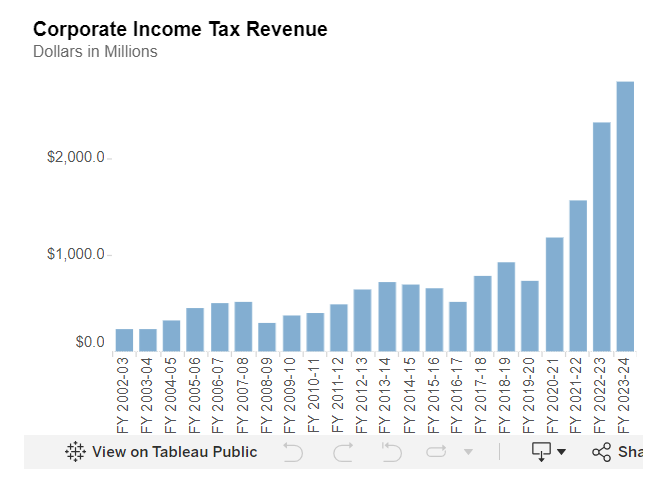
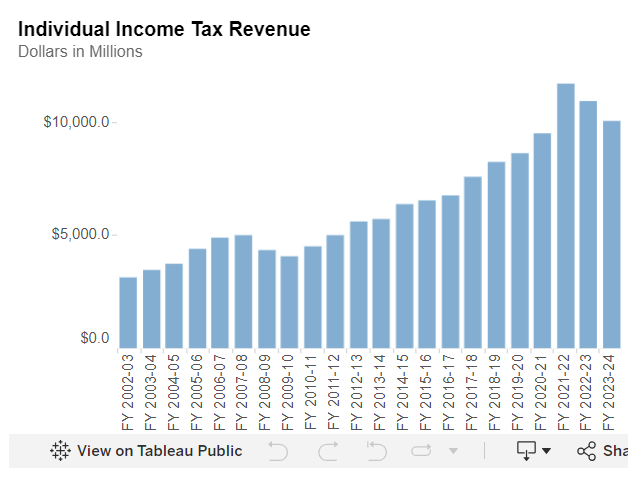
The two graphs below come from the Colorado General Assembly’s corporate and individual income tax pages, respectively. Both show tax revenue rose over the past four years.
Section 1(e) of the proposal states that “the Taxpayer’s Bill of Rights, or the TABOR amendment, has significantly limited the ability of state and local governments to invest in supporting teachers and care workers, building infrastructure, and keeping up with a changing economy.” The following subsections describe a range of underfunded needs.
That raises a fair question: With tax revenue increasing even under TABOR, where has the additional money gone? What were the additional funds spent on, and why weren't they spent on the priorities supporters claim are underfunded?
|
|
Counterargument: Bell argues that existing funding is inadequate for services essential to economic mobility. From that perspective, spending restraint alone does not address unmet needs. (bellpolicy.org)
A productive debate should ask which services need additional funding, what results taxpayers should expect, and how performance should be measured—not assume that either more or less spending is automatically better.
What if Amendment 87 and Proposition 136 Both Pass?
Proposition 136 would cap income-tax rates at 4.4 percent, conflicting with Amendment 87’s higher brackets.
The official Blue Book explains that conflicting voter-approved provisions generally turn on which measure receives more votes. However, it cautions that the exact result here is uncertain and could require legislative or judicial resolution. It would be misleading to promise a completely automatic outcome. (leg.colorado.gov)
Fiscal Impact
The final official analysis estimates:
| Fiscal effect | Estimate |
|---|---|
| Additional revenue, FY 2026–27 | $958.4 million |
| Additional revenue, FY 2027–28 | $1.972 billion |
| One-time Department of Revenue implementation spending | $98,000 |
The first year reflects a partial-year effect. These are forecasts, not guaranteed collections. (leg.colorado.gov)
The separately published official TABOR fiscal memorandum lists $2.7 billion as the maximum estimated increase for the first full fiscal year. That explains why the ballot question and central forecast use different figures. (content.leg.colorado.gov)
NOTE: This fiscal impact statement does not take into consideration any of the unintended consequences that are likely to happen and lower the projected revenue increases.
Conclusion
The strongest case for YES is that a graduated tax better reflects taxpayers’ ability to pay while supporting services that families need. That is the central argument made by Bell and the supporting campaign. (bellpolicy.org)
The strongest case for NO is that higher rates could weaken economic competitiveness, reduce long-term tax revenue as high-income earners and businesses leave, reduce job opportunities as businesses leave, and, over time, burden more people with higher taxes.
My takeaway is that two questions deserve separate answers:
Would this make Colorado’s tax system fairer?
And would the services it funds justify saving a few dollars per month for most people, but paying more in the long term? Remember, if you make $500,000, you'd save less than $100 per month on your immediate tax bill, and much less for most of us. But the proposal’s spending rules, accountability provisions, and long-term consequences matter a great deal.
Share & Engage
If you find this post useful, sign up for notifications of the next posts in this series.
What matters most to you: a common tax rate, ability to pay, public-service funding, or Colorado’s economic competitiveness? Share your thoughts—and reliable sources—in the comments below.
The Scoop on Colorado’s November 2026 Proposed Measures Series
Links to blog posts on all Colorado Amendments and Measures
- Amendment 81: Law Enforcement Communication with Federal Immigration Authorities
- Amendment 82: Constitutional Right to Purchase and Sell Natural Gas
- Amendment 83: Constitutional Right to Hunt and Fish
- Amendment 84: Mail Ballot Voter Identification
- Amendment 85: Plain Language Ballot Titles
- Amendment 86: Requirements for Off-Cycle Congressional Redistricting
- Amendment 87: Graduated Income Tax
- Proposition NN: Keep and Spend Money for Education and Other Purposes (coming soon)
- Proposition 132: Increase Penalties for Fentanyl Crimes (coming soon)
- Proposition 133: Penalties for Human Trafficking of a Minor (coming soon)
- Proposition 134: Male and Female Participation in School and Collegiate Sports (coming soon)
- Proposition 135: Prohibit Surgery on Minors in Response to Perception of Sex or Gender (coming soon)
- Proposition 136: Income Tax Limit (coming soon)
- Proposition 137: Direct Sporting Goods Sales Tax Revenue for Conservation (coming soon)